The rules of customer service changed when customer expectations did.
What used to be a linear interaction, one customer, one query, one resolution, has now turned into a layered ecosystem of conversations, expectations, data, and decisions happening all at once.
- Customers message across five platforms at the same time.
- They expect instant responses, but also deeply personalized ones.
- They want speed, but they will not tolerate inaccuracy.
And most importantly, they do not see “support” as a department anymore. They see it as the brand itself. This is where the real challenge begins. Because while expectations have grown exponentially, the underlying systems in many organizations have not. For instance:
- Teams are still scaling headcount to solve for volume.
- Agents are still navigating disconnected tools.
- Managers are still reacting instead of predicting.
Artificial Intelligence or a unified AI platform changes that equation. Not by replacing people. But by removing the structural limitations that make modern customer service difficult to scale, manage, and optimize.

The intelligence layer powering modern customer service operations.
Modern customer service runs on speed and scale. AI is becoming the infrastructure behind both. That is why, instead of simply adding more tools or increasing headcount, businesses are using AI to simplify workflows.
1. AI understands conversations
AI can quickly read customer messages, emails, and support history. It understands what the customer needs, how urgent the issue is, and the context behind the conversation.
2. AI helps teams make faster decisions
AI can automatically sort tickets, identify customer intent, prioritize urgent cases, and recommend the next best action for agents.
3. AI handles repetitive work
AI can respond to common questions, update systems, route tickets, trigger workflows, and complete repetitive support tasks automatically.
4. AI learns and improves over time
The more conversations AI processes, the better it becomes at supporting customers, improving workflows, and helping teams work more efficiently.
In modern customer service, AI works alongside humans. AI Assist helps agents respond faster with real-time suggestions and instant access to information. AI Agents handle repetitive and high-volume tasks independently, reducing workload and operational pressure.

How AI changes the economics of customer service operations.
Introducing AI Assist and AI Agents into customer service operations creates measurable business impact across efficiency, cost control, customer experience, and team productivity.
Operational efficiency
- Reduced cost per customer case
- Improved productivity across existing teams
- Higher support capacity without major team expansion
Response speed and service standards
- Quicker responses and faster case handling
- More accurate and uniform communication
- AI-supported service quality monitoring
Customer satisfaction
- No need for customers to repeat information
- Connected experiences across all communication channels
- More proactive customer engagement
Agent productivity and experience
- Reduced repetitive workload
- More time for high-value customer issues
- Faster learning and onboarding for new agents
Service resilience improves with AI. The outcomes prove how operations adapt to demand while maintaining consistent performance.
The entire ThinkOwl team is always at your service
ThinkOwl is your one-stop solution for all your customer support needs from case management to client engagement. Built on cloud architecture and molded in the SaaS model, ThinkOwl features AI-powered modules that streamline business workflows.
These solutions provide the perfect blend of helpdesk or ticketing systems, conversational or Generative AI technology, and a robust omnichannel environment for seamless customer interaction.
Some of the hallmark features of ThinkOwl — such as workflow automation, AI productivity tools, agentic AI, and smart AI assistance — are a real treat for thriving companies aiming to deliver stellar CX.


Most service challenges stem from recurring operational gaps.
1. The volume vs capacity imbalance
Occurs when customer requests grow faster than support teams can handle them. For example, during product launches or outages, sudden ticket spikes create long wait times and overloaded agents.
AI helps by instantly handling repetitive requests and routing tickets intelligently, enabling businesses to maintain fast, consistent support even during sudden demand spikes.
2. Fragmentation across channels and systems
Happens when customer conversations and data are spread across multiple platforms that do not work together seamlessly. For example, a customer may begin on email, continue on chat, and follow up on social media, while agents struggle to access the full context across disconnected tools.
AI unifies these interactions by bringing customer conversations and systems together into a connected experience that maintains full context across every channel.
3. The speed vs quality trade-off
Mistakes are bound to happen when support teams are pressured to respond faster without compromising accuracy or customer experience. For example, agents rushing through high ticket volumes may miss important details or create inconsistent experiences.
AI balances both by assisting with instant suggestions, accurate information retrieval, and faster resolutions without sacrificing service quality.
4. High operational costs, talent shortages, rising training costs, and no off-hour support
Customer service costs rise quickly when businesses rely on hiring more agents to manage growing ticket volumes. Training new employees takes time. Talent shortages slow scaling efforts. And providing reliable after-hours support often requires additional teams and higher operational spending.
AI reduces these costs by automatically handling repetitive customer queries, resolving common requests instantly, and providing consistent 24/7 support without requiring large support teams at all hours. It also assists agents with real-time suggestions and workflow guidance, helping new employees become productive faster.
5. Missing context in complex cases and missing sentiment understanding
Support teams often struggle when customer conversations lack full context or emotional understanding across interactions. For example, agents may miss previous conversation history, fail to recognize frustration in customer messages, or provide responses that feel disconnected from the situation.
AI helps by understanding the full conversation history and bringing relevant context into one place. It also detects customer frustration or urgency in real time. This allows agents to respond faster, with more clarity, empathy, and accuracy.
A practical guide for decision-makers to build scalable customer service with AI.
Every day, support teams face rising ticket volumes, higher customer expectations, disconnected systems, and constant operational pressure. Traditional support models are finding it harder to keep up.
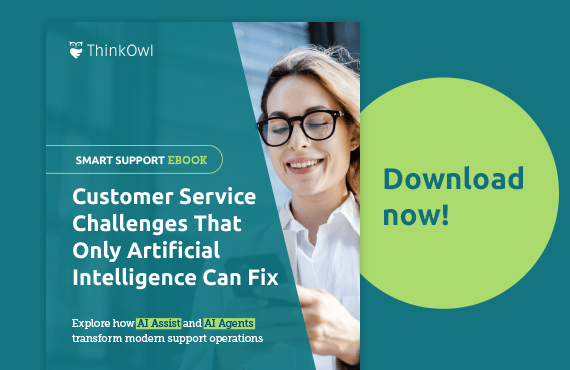
That is exactly why we created this eBook — Customer Service Challenges That Only Artificial Intelligence Can Fix — a practical look at how AI helps businesses simplify support operations and deliver better customer experiences at scale.
If the following challenges sound familiar, this eBook is for you:
- Customer service feels chaotic
- Too many tickets coming in
- Customers contacting via multiple channels
- Not enough skilled staff
- Costs keep going up
- Struggling to scale operations
The fact is many organizations try to solve these challenges by adding more tools or increasing headcount. But that approach is becoming less effective.
Our eBook explains why AI is set to become the foundation of modern service organizations — and how you can use it to solve the pressing customer service challenges sustainably.
Download your free copy now!
Scaling operations without adding complexity
As your business grows, things can start to feel unclear. More tickets come in. More people get involved. Processes begin to stretch. That’s when gaps show up.
With ThinkOwl, growth feels structured. The experience stays the same, whether you have 10 agents or 100+. You can:
- Define a focused and practical use case
- Begin with AI-assisted workflows or choose the right use case for autonomous AI Agents
- Expand automation step by step
- Integrate existing systems into a unified intelligent service ecosystem
Everything stays organized as volume increases. No forced restructuring. No operational mess. Just a system that adapts as you grow.