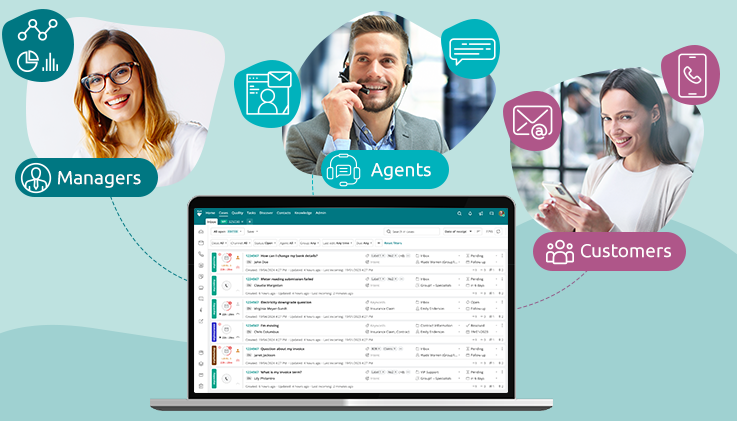
In many service departments, there is a fundamental contradiction. On one hand, customers expect personalized and empathetic support. On the other hand, organizations aim for efficiency, with lower effort and faster processing. Reconciling these expectations has long been a challenge.
For a long time, these goals were treated as opposites. Personalized service was seen as time consuming, while efficient service was considered impersonal. This is exactly where platforms like ThinkOwl change the equation. Modern service processes no longer need to be complex to be effective. The focus has shifted toward reducing effort per case through intelligent structures and automation, while maintaining service quality.
A new principle for efficient, high-quality service
This approach is known as “Low Touch, High Impact.” ThinkOwl was designed with this principle at its core.
The difference becomes visible from the very first interaction. When an inquiry arrives, ThinkOwl automatically analyzes its content. The platform identifies the topic and tone, determines urgency, and forwards the message to the appropriate destination. Instead of sorting through crowded inboxes or manually assigning requests, agents focus only on relevant cases with full context available immediately.
This saves time and reduces cognitive load. When agents no longer need to constantly reorient themselves, they can work with greater focus and speed. The result is higher quality output with less strain.

Automating routine service without losing quality
ThinkOwl also shows clear advantages with standard inquiries. Simple requests such as password resets or status updates no longer require human handling. These interactions are resolved automatically by the conversation bot at any time of day and across supported channels. Customers receive accurate responses quickly, while service teams are freed to focus on more complex matters.
Even when human involvement is necessary, the required effort remains low. ThinkOwl delivers the case together with suggested responses and relevant templates. It also provides clear next steps within the process. Agents spend less time searching for information and more time making informed decisions.
Measurable impact on service performance
The impact is measurable. Processing times are reduced and error rates decline. Follow up inquiries become less frequent. Service efficiency improves without customers feeling rushed or underserved. In many cases, faster and more precise handling even increases the perceived quality of service. What matters is not only what is done, but how appropriately it is handled.
A telecommunications provider offers a good example. Previously, callback requests were managed manually. Calls were logged and follow ups were scheduled. Escalations were tracked using spreadsheets. With ThinkOwl, callback requests are now detected automatically. The information is routed directly to the correct queue and linked to the original request. Depending on the case, it is either assigned to an agent or handled by the voicebot. As a result, processing time per case dropped by more than 60 percent, while customer satisfaction increased significantly.
This captures the essence of the “Low Touch, High Impact” approach. Processes are designed to feel effortless for everyone involved, while delivering meaningful results.
Conclusion
ThinkOwl is not designed to replace people. It is built to remove unnecessary work and accelerate service processes. Service does not improve by adding more resources, but by using existing ones more intelligently. At a time when speed is critical and quality remains essential, ThinkOwl delivers both.
Explore solutions by ThinkOwl, and book a free demo.