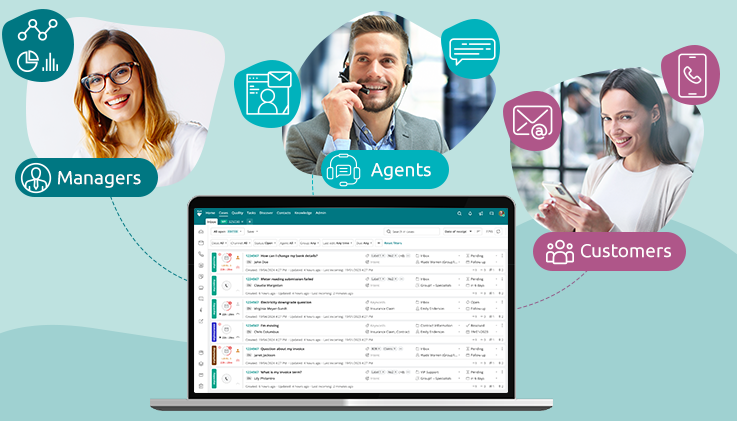
Companies no longer work with a single software solution, but rather with an ecosystem of specialized solutions. CRM, ERP, DMS, accounting tools, chat platforms, telephony, e-signatures, and marketing automation all shape daily operations. What is often missing, however, is the connecting hub: a central platform that intelligently links information, communication, and processes.
This is precisely where ThinkOwl positions itself not as a self-contained solution, but as an open, integration-ready center for modern service architectures. The platform was deliberately designed to integrate seamlessly into existing systems, helping to break down data silos and automate workflows. It also brings customer communication to where it belongs: right into the heart of the organization.
How ThinkOwl fits seamlessly into existing IT landscapes
It starts with the standards: ThinkOwl has a modern REST API that is fully documented and can communicate with any other system that is also API-enabled. In addition, webhooks are available to send events to third-party systems in real time – for example, when a new ticket is created, a case is closed, or a specific process status is reached.
In practice, this means that if a customer submits a contract termination via email, ThinkOwl can automatically flag the customer's master data record in the CRM. It triggers a cancellation workflow in the ERP, initiate a retention offer from the marketing tool, and simultaneously inform the legal department. Everything happens synchronously and transparently without any manual intervention.

It becomes particularly exciting when ThinkOwl is integrated into more complex process chains. Many companies use the platform as a frontend for structured communication, while several backend systems are involved in the background. The customer is unaware of this – they have a clear, consistent point of contact or a seamless bot dialogue.
From integration to orchestration
Internally, however, ThinkOwl orchestrates all the steps and distributes tasks. It collects information and brings it all together. Existing specialized solutions can also be easily integrated. Document management systems such as d.velop, ELO, or DocuWare can be connected to automate archiving processes. E-signature services like DocuSign or FP Sign can be seamlessly integrated to send contracts directly from ThinkOwl for signing. And those who work with tools like Microsoft Power BI can prepare ThinkOwl data via interfaces for visualization and analysis enabling better decision-making at the management level.
The goal is always the same: to avoid media breaks, accelerate processes, and make information available where it is needed. Every manual intermediate step carries the potential for errors. It consumes time and ultimately weakens the customer experience.
ThinkOwl therefore sees itself not as a closed platform, but as a flexible component of a larger whole. And that is precisely why an active partner ecosystem is growing around the platform: technology providers, integration partners, consulting firms – all with the goal of helping companies optimally integrate ThinkOwl into their existing IT landscape.
The major advantage: This ecosystem makes it possible to implement projects faster by utilizing the best practices and leveraging proven connections. For customers, this means less effort, lower risk, and faster, tangible results.
Conclusion
Ultimately, it is not just about connecting tools. It is about making customer service smarter – automated and integrated. ThinkOwl makes this possible as a platform that does not push itself into the foreground, but rather connects everything in the background. Because the best service is created where systems work together, not in isolation.
Explore solutions by ThinkOwl, and book a free demo.