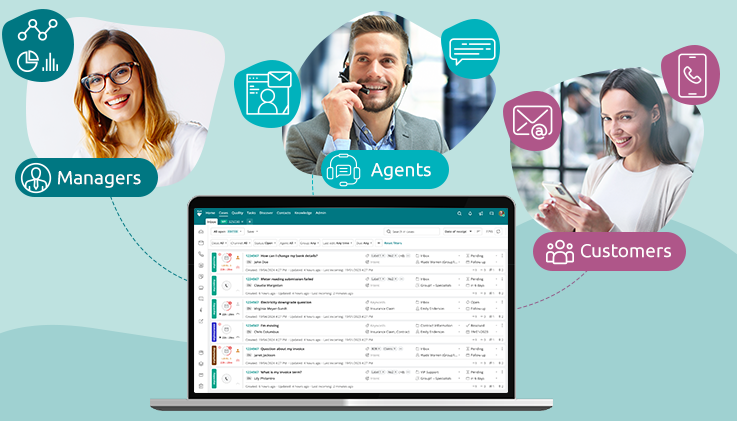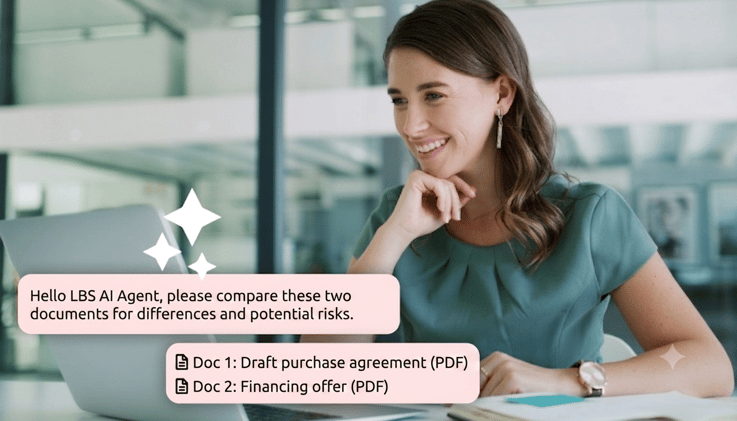
In this blog post, we are going to look at some real-world success cases. A few of ThinkOwl’s clients were managing high volumes of queries across email, forms, and other channels with no reliable way of identifying what customers actually wanted. To break this cycle, they put ThinkOwl's Conversational AI to work. The intelligent bots that go beyond scripted responses and align perfectly with customer expectations.
Before we dive into the clients’ success stories, let us first understand what makes ThinkOwl's Conversational AI and Omnichannel Bot capable of solving these challenges.
Conversational AI: Built to understand, built to scale
Organizations can leverage ThinkOwl’s Conversational AI to take the next step towards automation and handle customer queries in any form (voice, emails, chat). Powered by advanced large language models and built directly on the ThinkOwl platform, the bot is capable of going beyond simple question-and-answer interactions. They understand intent, track context across a conversation, and respond to every query naturally just the way a human would. Now, let us look at how they were able to overcome unique issues in their customer support with conversational AI.
Success case 1: LLM-powered email conversation for complex customer requests
Problem — A tele-sales agency was receiving customer queries on email regarding missed newspaper deliveries or requests for temporary delivery suspensions. The queries did not have clear context which forced the agents to follow manual steps which included reading, interpreting, clarifying, and executing follow-up actions. Indirect date references and multiple intents within a single email could not be interpreted reliably. This became a human-dependent process to accurately understand customer language.
Solution — ThinkOwl’s advanced email conversation bot powered by LLM-based AI transformed chaotic email handling into a structured, reliable process. It accurately detects multiple intents within a single email, extracts key information such as delivery dates and suspension periods, and intelligently interprets relative expressions like “yesterday” or “next week” into actual dates.
Configured with company-specific context, the bot understands operational nuances around delivery cycles and customer phrasing. Extracted data is automatically passed to the client’s SAP system via API, triggering end-to-end processes for missed delivery complaints and temporary suspensions.
Outcomes
-
Up to 70% reduction in manual email handling.
-
Accurate processing of data, even when customers used vague or relative language.
-
Reliable understanding of multiple intents within a single email.
-
Higher automation resulting in better ROI (compared to the previous phone-only bot).
Success case 2: Automating heating system inspection queries with AI voicebot
Problem — In Austria, gas heating systems are subject to a mandatory safety inspection every 12 years. So, a regional electricity and gas grid operator used to inform concerned individuals by sending them letters, mentioning their gas or water heating system must be checked by a certified maintenance provider. When customers received these letters, they used to frequently call to Why was the inspection required? Whether the obligation applied to them personally? What to do if they were not the property owner? How to provide proof of compliance? Agents spent a large share of their time clarifying regulatory queries rather than handling other service requests.
Solution — With AI voicebot, the client was able to route inbound calls related to gas safety inspections through a short IVR flow first. Customers were then asked whether their inquiry relates to the gas safety check. If confirmed, the call was transferred to the voicebot. The bot was trained specifically on the content of the inspection notification letter, typical customer questions triggered by the letter, and regulatory explanations relevant to gas safety compliance.
Based on this, the bot provided clear, consistent answers to common questions. If a caller asked something outside the scope of the gas safety inspection, the call was automatically forwarded to a human agent. By automating responses to standard gas safety questions, the voicebot shielded agents from predictable call surges. This kept daily operations stable while maintaining response quality.
Outcomes
-
Automated handling of gas safety–related inquiries after letter distribution.
-
Reduced agent workload for repetitive regulatory explanations.
-
Consistent and accurate answers aligned with official communication.
-
Informational calls are handled automatically, with agents supporting only exceptions.
Success case 3: Automating heating system inspection queries with AI voicebot
Problem — A statutory insurance provider for Germany’s construction industry identified individuals working in construction companies and sent them official letters requesting registration. The letters explained why registration is required, what legal obligations apply, and how to complete the registration process. Despite the information being clearly stated, many recipients still called customer service with questions. Most calls were not about complex cases, but about understanding what to do next. Agents spent a significant amount of time explaining the same steps again and again, even though the next action was filling out the registration form.
Solution — Handling inbound calls related to registration requests became easier with ThinkOwl’s AI voicebot. It provided clear, step-by-step guidance for registration based on the content of the official letters. The bot was trained on the content of the registration letter and typical customer questions about mandatory registration.
During the call, the bot explained the process clearly and provided a direct link to the online registration form. Customers were instructed to submit the form, after which the client’s internal processes determined whether the registration was valid or not. The voicebot absorbed the majority of clarification calls, preventing contact center overload during peak periods. This allows the client to maintain stable service levels without increasing agent capacity.
Outcomes
-
Automated handling of high-volume, registration-related inquiries.
-
Consistent guidance aligned with official communication.
-
Faster redirection of customers to the correct registration process.
-
Clear separation between guidance during calls and validation after submission.
Success case 4: Conversational AI to automate form-based workflows
Problem — A consumer goods company relied on handwritten forms for order placement and customer requests. Their customers would submit scanned documents or physical forms via emails making document processing the main operational challenge.
Since there were multiple form categories with inconsistent handwriting and layout, extracting usable data from these documents completely depended on manual review. Maintaining data accuracy was difficult in such a scenario and processing a single form took up to 42 seconds, making the operations difficult to scale.
Solution — The client deployed ThinkOwl’s Conversational AI to automate the processing of handwritten forms. It leverages LLM-based document understanding so forms such as new customer order forms, return forms, delivery sheets, and replacement forms, were configured to define relevant fields. AI accurately extracts information from relevant fields despite inconsistent handwriting or unexpected layouts.
Each form category was then linked to a search-list that further improved precision by allowing the bot to identify correct products and adapt to changes without workflow disruption. Documents were fetched from email attachments and external scanning partners via custom API into a unified flow. Extracted and validated data is automatically transferred to a booking system, enabling fully automated order processing with minimal human intervention.
Outcomes
-
45% of orders are fully automated, with no human intervention.
-
Processing time significantly reduced from 42 seconds per form to 7-8 seconds per form.
-
Reliable extraction across multiple handwritten document types.
-
Accurate product and category identification through configurable search lists.
-
Consistent processing of documents received via email, post, and custom API channels.
Success case 5: AI voicebot to automate waste collection requests
Problem — A waste management company was receiving a high number of inbound phone calls to seek information about which specific waste type (paper, residual waste, organic waste) will be collected on which specific day or week of a month. The support team was receiving the same questions throughout the day and agents had to look up schedules during live calls. Traditional chatbots were not suitable for this scenario. They struggled to understand free-form spoken questions, especially when customers combined waste type and time reference in a single sentence.
Solution — ThinkOwl provided an AI Voicebot that uses advanced language understanding to interpret how customers naturally ask questions. It identifies the waste category mentioned in the call to fetch the relevant date or time reference (e.g., a specific day or week in a month). Based on this, the voicebot responds directly with the correct pickup information. If a question cannot be resolved confidently, the call is transferred to a human agent.
Smart conversation bots eliminate the need for agents to manually search schedules during live calls. Instead of placing callers on hold or transferring requests, information is delivered instantly. This improves call flow, reduces handling time, and ensures residents receive immediate, reliable answers.
Outcomes
-
Immediate answers provided by phone for waste collection schedule queries.
-
Reduced agent workload for repetitive calls.
-
More reliable handling of naturally asked customer questions.
-
Improved accessibility for residents who prefer calling over digital channels.
Real transformation starts with ThinkOwl’s Conversational AI
These clients did not see the AI bot implementation as a substitute for human interaction. The goal was to ease pressure on their teams and drive higher value for their customers. ThinkOwl’s Conversational AI is capable of demonstrating its versatility across various business cases. With the right transformation roadmap, you can make the bot part of your bigger CX strategy accelerate service operations for better customer experience.
Built on ThinkOwl’s unified AI platform, this solution can be leveraged to solve the most painful channel and embody a business’ tone and communication style. Integration with internally customized applications or third-party solutions is easy. You can pull real-time data across tools and deliver context-aware assistance, every time. Explore solutions by ThinkOwl, and schedule a free demo.